
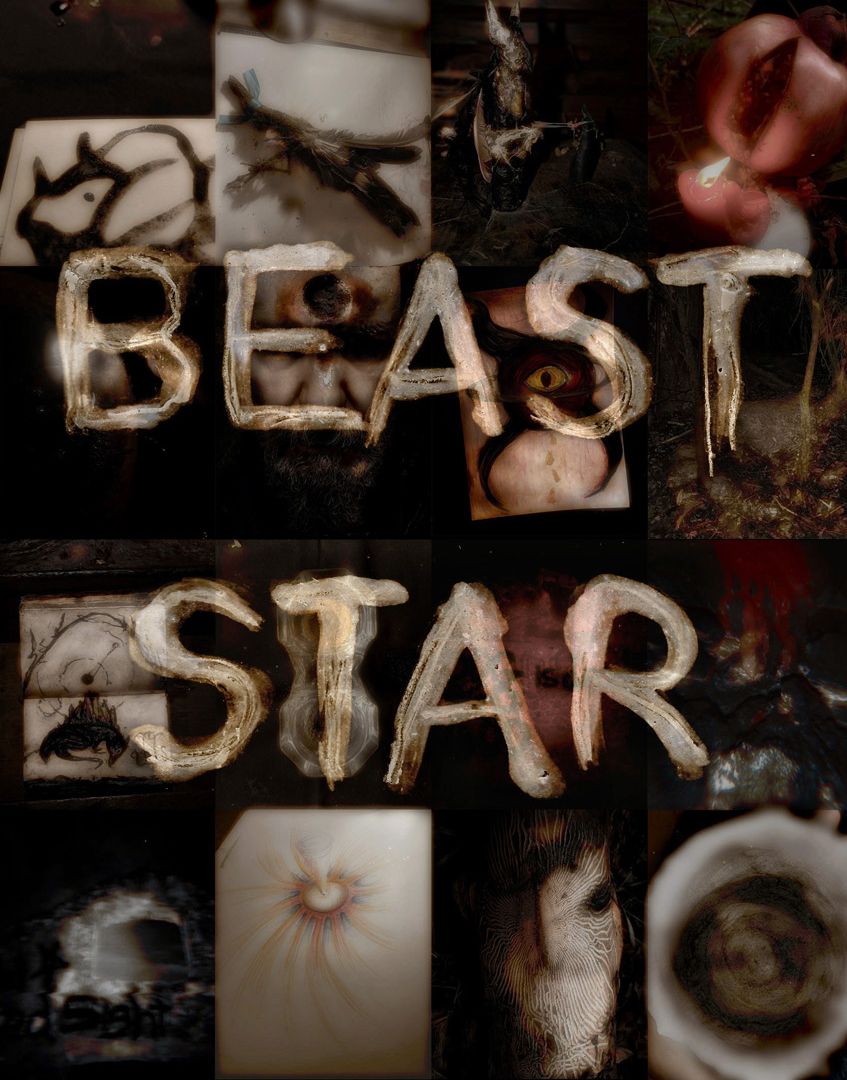
This small archive gathers images and texts of those who took part in the rite on 29 March 2025, which aimed to follow the Star of Night into the Underworld and associate with the transformative power of the Black Dragon at work there.
Since I assume that those who visit my website do so to find out about my work, I have been rude enough to put my images first. This does not in any way imply that they should be considered a priority. The order of images and text could just as easily be constructed differently.
The impulse came from Sharon Moyal and myself, and then Konrad Kruse joined us, and together we engaged in intense preparation. Later, C. Scorpius, ภค๏, Arianna Arya and Marta Heberle joined in, inspired by what we had set out to do, and performed their own rites at that moment. We worked in different geographical locations (Belgium, Israel, Germany, France, Italy, Poland) and created a connection that crossed boundaries in more ways than one. Ultimately, however, such rites are embodied experiences to which each person must give their own testimony.
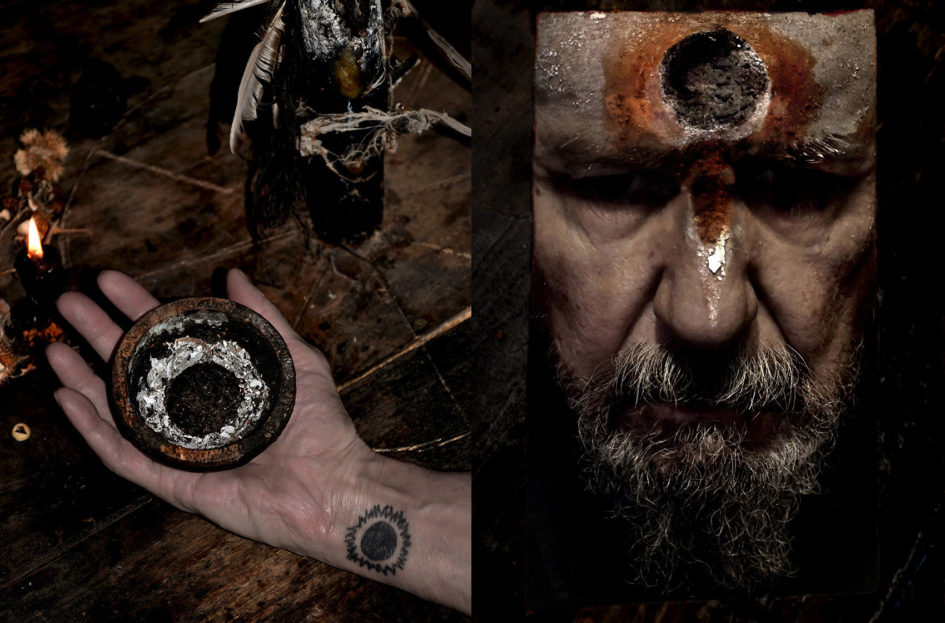
Marta Heberle pointed out to me that my bindu point in the photo would look like a hole in my head burned by a meteorite. And that’s how the ritual work that night felt to me, like a hole being drilled. After the visual meditation I felt the emptiness it had left for several days. Such work takes something from you. But it also gives something back, and now the hole is filled with new energy.
From the conversations I had I realised that I was not the only one who felt this way. Some had used the rite as a way of releasing themselves from a period of closeness to death and the experience of grief. But even if it wasn’t so existential for everybody, everyone I spoke to told me that the experience was ultimately empowering for them. And that is what sorcery is all about.
The dynamic force of dragonness will continue its revolutionary work, sometimes deep in the ground of existence, sometimes breaking through human systems. What if we turned it into a guerrilla performativity capable of corroding the configurations that prevent the elaboration of a bioontology that is urgently needed to confront the global threats that lie ahead?
Seven was the number of us. Seven steps down the ladder to the otherworld.
This is only a beginning.
***
Gast Bouschet
Part Two.
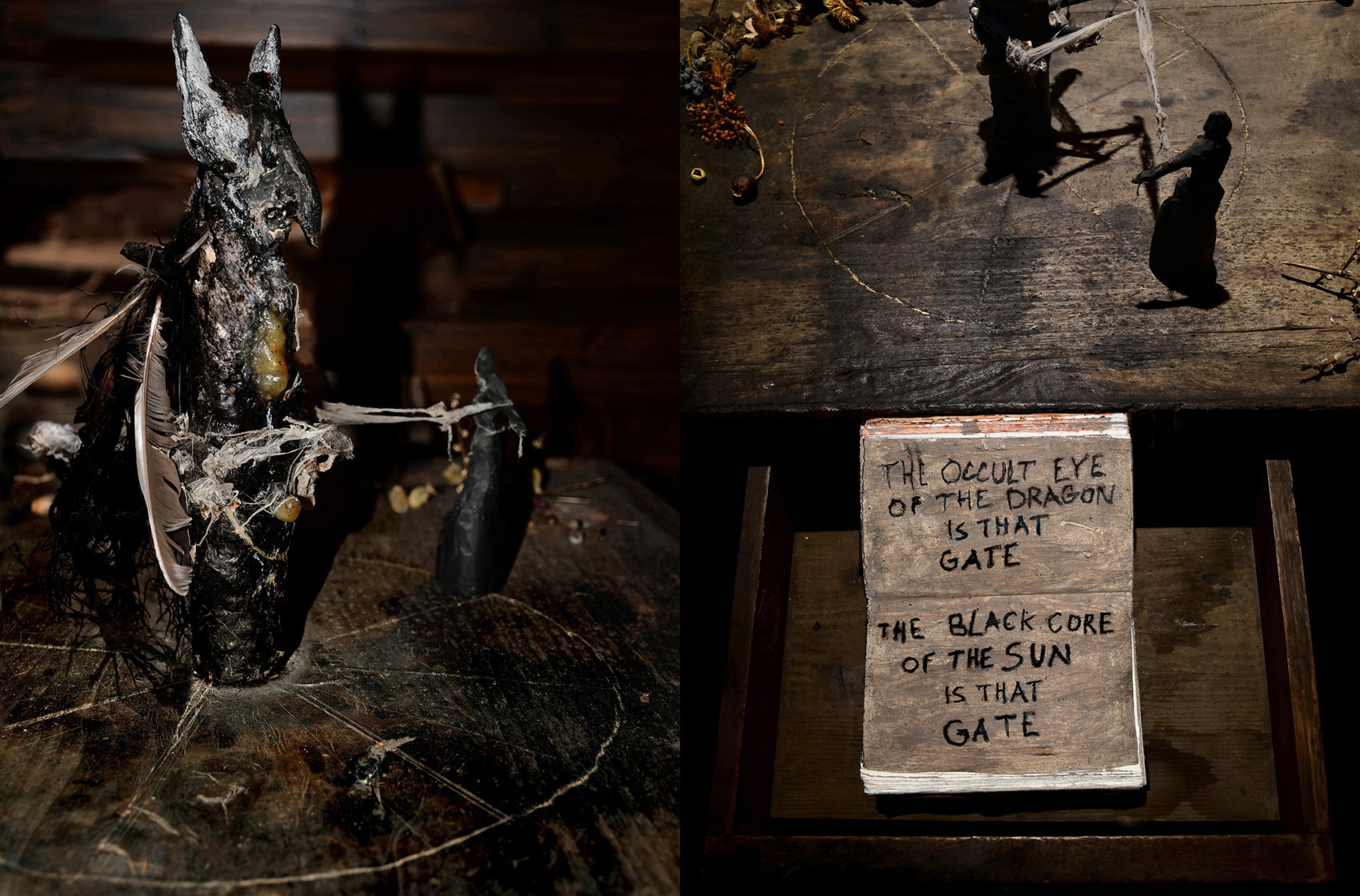
Corroded throne of light above
The depths of embryonic night.
Part Three. The way through things.
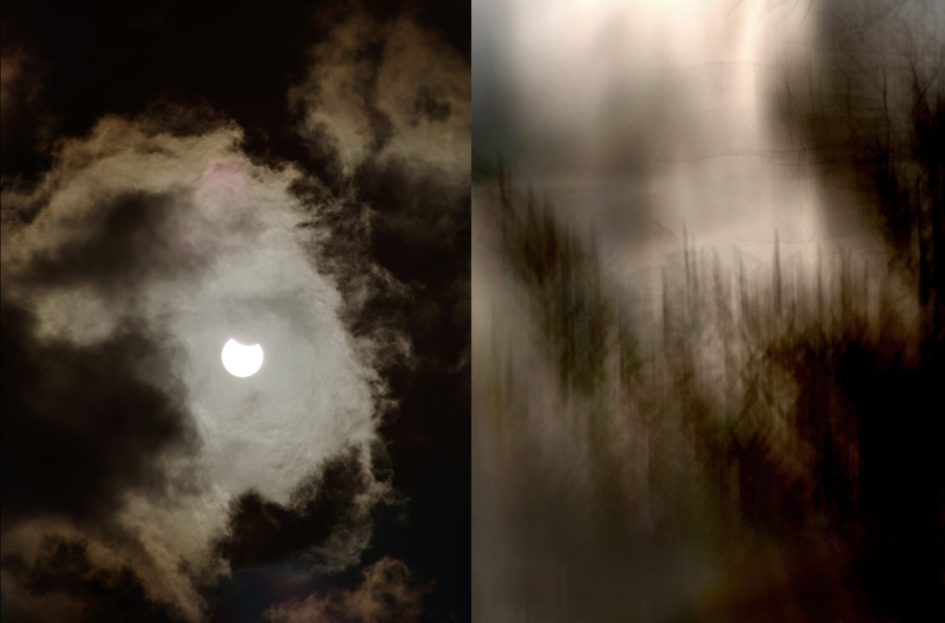
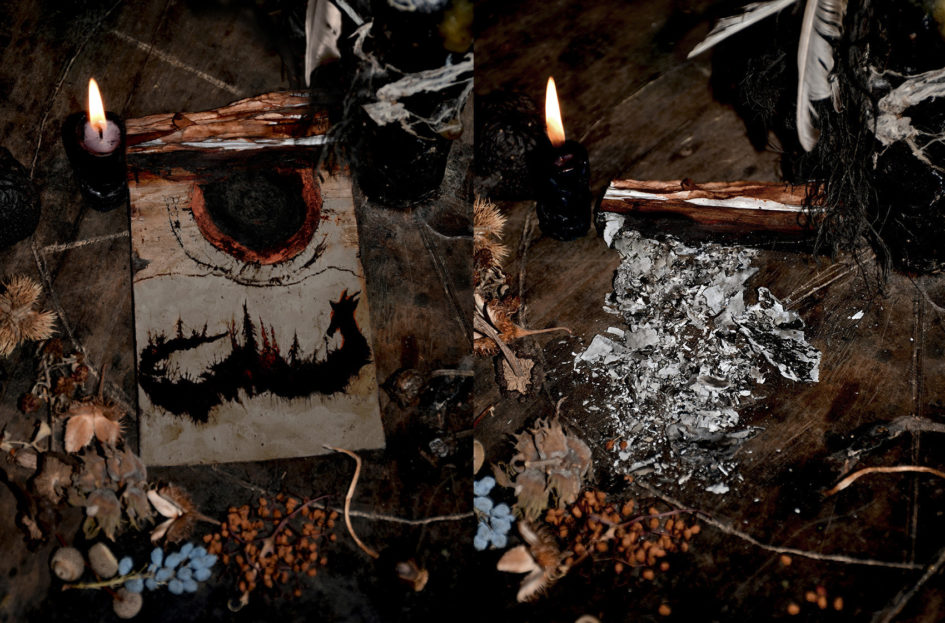
The drawing was made during the partial eclipse of the sun on 29 March and is an attempt to give form to a hypnagogic vision I recently had while falling asleep. In it I saw the Ardennes Forest, which is often divided into parcels, mutating into the shape of a dragon. A setting black sun crowned the scene, both vanishing point and gateway to the chthonic depths of the universe.
As the eclipse coincided with Saturn’s escape into the unmanifest, Sharon, Konrad and I had agreed to project the lead that weighed on us into the drawings we would make during the eclipse. And then we would burn them and mix the ashes with bone charcoal (in my case from a goat’s skull) to mark our foreheads with a bindu, the seed point and star gate into the creative and regenerative power of the primordial universe. In a second cup I prepared a turmeric paste to create the surrounding halo, ‘the solar fire that frames the darkness’, as Sharon put it.
At sunset, the second part of our ritual work began, which consisted of entering into a meditative state and following the sun into the underworld. Our journey was preceded by a period of intense preparation, during which we discussed how we could use liminal spaces to mediate between stellar and chthonic energies, and how we could create a collective vision beyond what we had been able to imagine individually. But when it comes to visceral experiences, you are always thrown back into your own body, and ultimately I can only testify to what I myself went through.
This is my account.
There is a shaft into which the yolk falls. It wobbles as only suns and eggs wobble. It expands when it inhales and contracts and holds its breath when it has to to squeeze through chokepoints.
I feel the ground down here, icy and slippery, and scry for prophecies of ancient wisdom in the walls and ceiling, all of which are made of black volcanic glass. How they layer and move, like geological plates or the scales of our black dragon. In the centre of the cave lies the exit of the mine shaft through which the sun is pushing.
Part Four. That what is difficult to endure can still be endured.
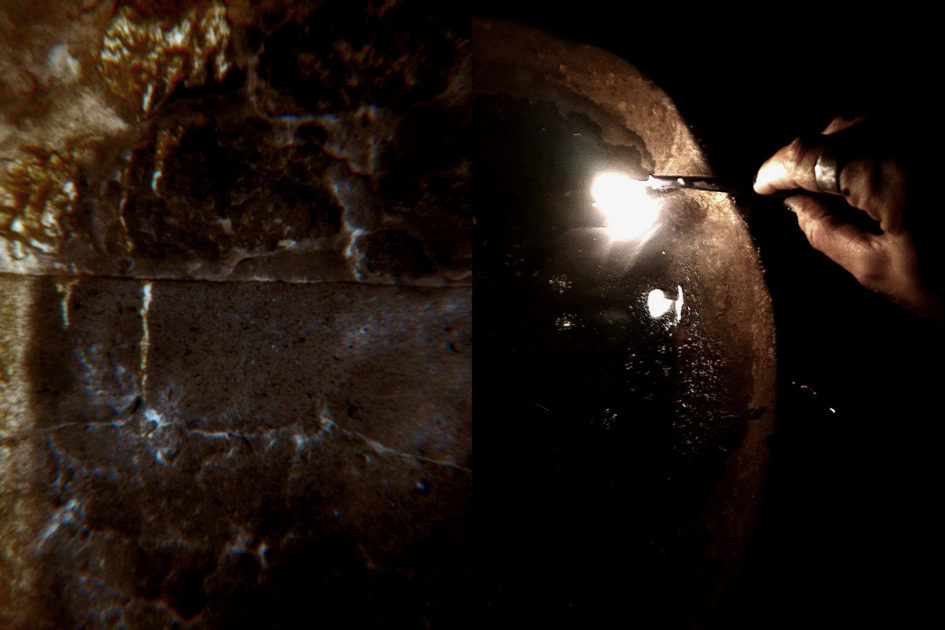
The yolk has made its way inside, slowly, like a child pushing through the birth canal. The crowning moment has come, the contractions have pushed it far enough to stretch its head through the opening. During the birth, its membrane rubs against a sharp edge of the obsidian wall and bursts open. Liquid gold spreads throughout the cave, fusing with the volcanic glass and illuminating it from within with a dark glow.
Survival means adapting and requires the ability to act. The Grotto knows this, and has taken advantage of the contamination with the sun essence to undergo its metamorphosis from larva to volcanic snail. The iron mass of its shell exerts a gravitational pull that draws us into its body. Loose clusters of cells form a porous structure that expands in all directions. Each cell it’s own creature, bound together by a common force.
Day’s been long for me. The chronic pain lights a fire that intensifies to an annoyingly high level tonight. The alchemical treatises hide the pain the salamander suffers in the fire. A new wave of labour sets in, pushing us towards the light pulsating in the eastern corner of the cave.
Suddenly! Out there! A vision straight out of the Hadean Eon*. A molten planet, battered by asteroid impacts and volcanic eruptions. Rocks hurled into the air by the dragon’s breath. Look up, up, up. A universe bathed in red and black. My eyes, no longer human, see an infinite number of suns pulsating in black light. An infinite number of dragon cells, each imbued with autonomous agency. An ouroboric cycle of pain and power, feeding on itself to sustain itself. Burn, burn, burn.
*Named after Hades, the ‘invisible’, the Hadean is the oldest geological age on Earth.
Here ends the report.
What this means for my future individual and collective work remains to be seen. Perhaps I will share further insights on this later, or take inspiration from Saturn, water the seeds of transmutation in the dark and wait patiently for them to bear fruit.
Notes from the Dragon’s Lair. April 2025.
***
Sharon Moyal
Occult Photography. Part Four.
Simply put, when we look at something, light reflected from it enters the eye through the pupil (i.e. a hole) and is processed into images by the brain. Photography mimics this process, and the photos I value most remind us that light enters both the body and the camera through a black hole.
In film photography, a latent image is created in the light-sensitive emulsion and made visible through a chemical development process. From an occult perspective, this means that black light and the entities that inhabit it are captured in a layer consisting of gelatine (i.e. crushed and melted animal bones), crystals and silver salts.
In digital photography, the camera’s sensors convert light photons into electrical signals. From an occult point of view, this process converts demonic particles into charges that generate sorcerous images. AI photography is something else entirely, as it uses algorithms to generate images from data. This is outside my area of expertise, so I will not comment on it. Besides, no one knows what the future will bring in this regard.
Over the past 50 years, I have spent roughly equal amounts of time practising analogue and digital photography. Here are some thoughts that I believe apply to both.
The photographer’s alchemical task is to fix the volatile and to volatilise the fixed. Most photo theorists will agree with me on the first part of this statement. Many have pointed out that photography freezes the world into immobility. In his book Camera Lucida, Roland Barthes even claimed that photography takes life, describing photographers as ‘agents of death’. But Barthes was also aware of the magical nature of photography and tried to bring his mother’s essence back to life through the medium.
The relationship between photography, mourning and death has been extensively explored, and many associate the term ‘occult photography’ with early 20th-century ghost photography. However, my focus is on the contemporary and the redistribution of agency within the photographic process. This is ultimately a political issue.
Occult Photography. Part Five.
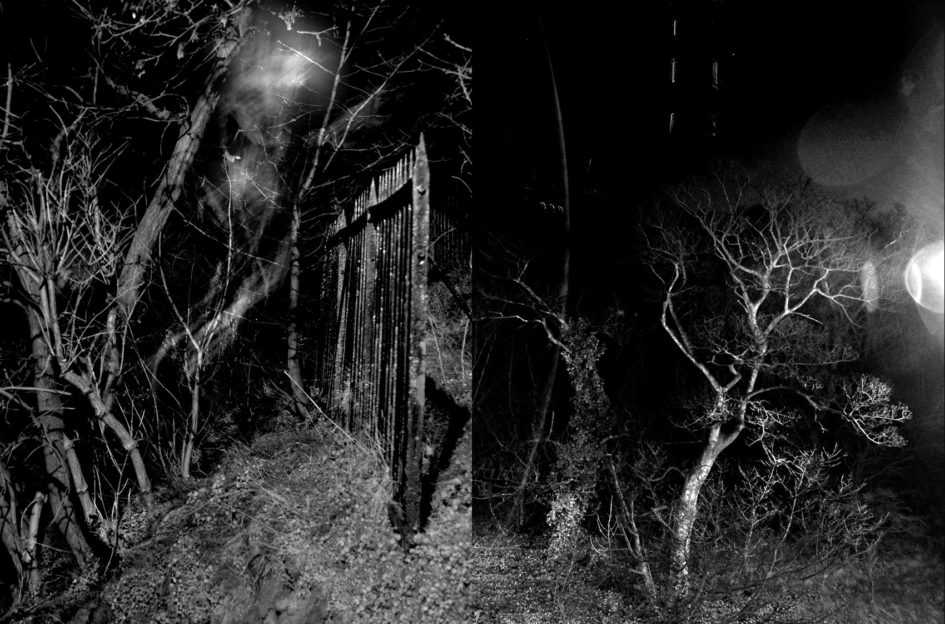
Whether we are politically motivated or not, whenever we take a photograph, we exercise power over what it depicts. We all play a role in the exercise of political power, whether we are aware of it or not. When we point our cameras at the world, we are not documenting reality – we take possession of it. The demonic aspect inherent in the word ‘possession’ is deliberately chosen here. We gain control over what we show and claim ownership of it. Photographs are never neutral. And they always have power.
During the colonial era, for instance, photography was a weapon used to bring order to what was perceived as wild, chaotic, and threatening. For those interested in exploring how it was used against colonised populations, I recommend reading “an alle orte die hinter uns liegen” by Sinthujan Varatharajah. Unfortunately, it has only been published in German so far. The book shows how Europeans deliberately used the camera to assert their own humanity by subjugating other life forms. Important insights, as these mechanisms are still at work today.
But despite all my criticism of photography as an instrument of domination, I believe in its revolutionary potential. By combining our creativity with that inherent in the medium itself, we can challenge the human-centred perspective and pave the way for profound change. Occult photography is also a weapon, but it draws on the power of the accidental, which undermines any unilateral claim to authority. Furthermore, the contaminating lights and shadows that constitute its sorcerous essence counteract the clean evil of aesthetic capitalism.
At the heart of photography lies the question of ownership and what is actually captured in a photograph. Several elements are superimposed: the image that the subject radiates into the world; the photographer’s appropriation of this image from their own perspective; the accidental elements and mistakes that affect the image and give it its spellbinding impact; and last but not least, the photographic materiality itself. A photograph is not merely an image of something else; it has its own ontological reality.
Occult Photography. Part Six.
My aim is not to celebrate the stillness of the photographic image. The French expression ‘sage comme une image’, meaning ‘as well-behaved as an image’, expresses what I avoid. I am not concerned with polite, detached contemplation, but with engaging with the predatory shadows that constitute the very essence of occult photography.
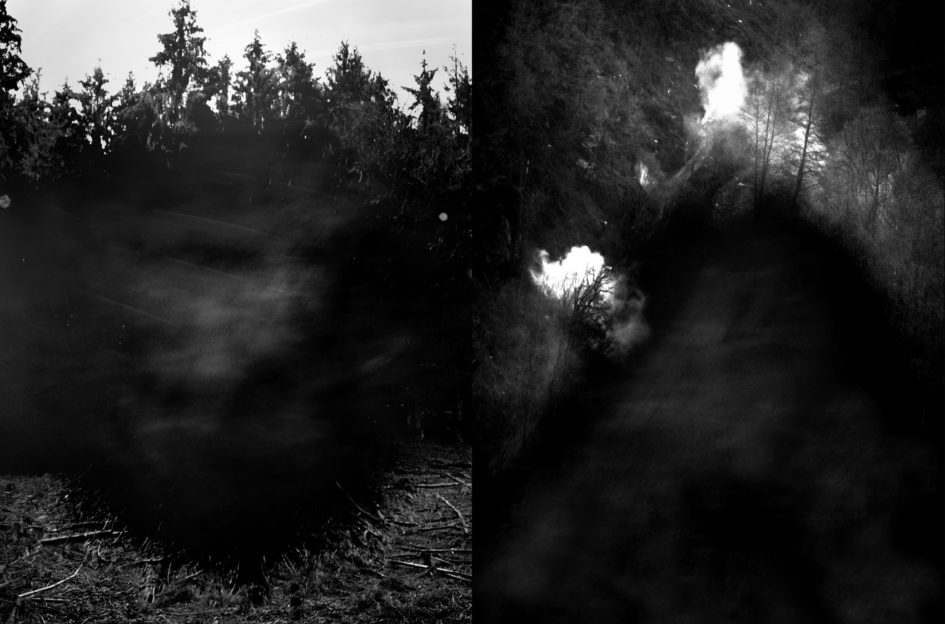
Don’t think of shadows as the absence of light, but as a demonic presence that spreads contagiously. When it takes hold of photographic matter, it becomes a living shadow. When it does not freeze. When it absorbs black light and does not let it rest.
Both the photographer and the photograph must crave the shadow. Shadow work is hungry work. Without hunger, there is no occult photography. And hunger is only hunger when it cannot be satiated. The photograph must not be stilled. The fixed must be volatised.
Conventional photography is an act of appropriation. There is a reason why it is said to be akin to stealing souls. Pursuing this idea from a contemporary philosophical perspective makes it clear that not only human souls are stolen. Photography takes possession of everything whose image it captures, the entire “landscape,” a term that in itself reflects the human-centred perspective.
This is where occult photography reveals its revolutionary potential. It enables us to escape the hall of mirrors that traps us in our own reflection and connect to the wider planetary system. Up to this point we are still on relatively safe academic ground covered by environmental philosophy. It is when it is put into practice that it becomes groundbreaking. When we actually become the ‘other’.
I will return to the practical aspect in my ongoing investigation of Becoming Demonic, which I’m conducting with Sharon Moyal and other sorcerous artists. For now, let me conclude this exploration of occult photography by noting that it reflects the profound crisis of perception that we are witnessing today. Drawing on the breakdown of reality in the 21st century, occult photography paves the way for a profound shift in our fundamental understanding of existence and our relationship with the world.
Gast Bouschet, 10 September 2025.